
Clothes Bin®
What Is Clothes Bin?
Clothes Bin is a franchise for operating recycling collection bins for clothes, shoes, and textiles. Franchisees place the franchisor-specified collection Bins at leased public locations within a designated territory and must collect, manage, transport, distribute and resell the collected items using the Clothes Bin system and proprietary tools. It serves the general public as donors and derives revenue by selling the collected clothes, shoes and textiles to businesses in the textile recycling, thrift and retail sectors; core assets include the specified Bins and the proprietary Bin Location Information Program (BLIP) for mapping, tracking and monitoring.
Clothes Bin Franchise: Pros and Cons
A key strength is zero outlet terminations to date, indicating strong franchise stability; however, 27 signed-but-not-open outlets raise a major risk that the franchisor may be selling faster than it can support openings, especially given only 8 training hours and 2 outlet non-renewals.
Pros
Cons
Sales / Revenue
The 2025 FDD appears to include Item 19 financial performance information, but ZeeReport is not showing a number for this report.
Why no number is shown
The available metric did not appear to be location sales or revenue.
Important limitations
When ZeeReport cannot safely identify the source figure, population, or calculation path, the report does not publish a financial number.
Lawsuits & Legal Risk
Clothes Bin reported no material legal proceedings,
Territory Protection
Clothes Bin grants a protected exclusive territory (map/ZIP/description) of ~150–350 potential gas station/convenience-store Bin sites, allowing intra-territory Bin relocation but not Territory amendment. Rights depend on compliance and performance quotas; franchisor may develop nearby units and sell via alternative channels in or near the territory, without offering first refusal.
Training & Support
The brand provides a streamlined 8-hour training curriculum designed to prepare two individuals for launch. The program includes on-site launch support to assist operational readiness, with travel and lodging expenses and any additional on-site support fees the responsibility of the franchisee.
Franchisee Stability
Clothes Bin receives a Poor Stability Score. Three-year turnover of 9.00% is well above the typical Retail franchise (around 5%). Out of 9 total exits, non-renewals and ceased operations were the largest categories with 3 each, alongside 2 terminations and 1 franchisor buyback.
The tie between non-renewals and ceased operations suggests a mix of contract-level departures and location-level closures: some operators chose not to continue, while others closed units that underperformed. Given this pattern, probe unit-level economics and local-market performance, and ask the franchisor for recent examples of how it supported or sought to recover underperforming locations. For prospective franchisees, this warrants additional diligence: review Item 3 litigation disclosures, Item 17 termination triggers, and conduct interviews with current and former franchisees.
Unit Growth Analysis
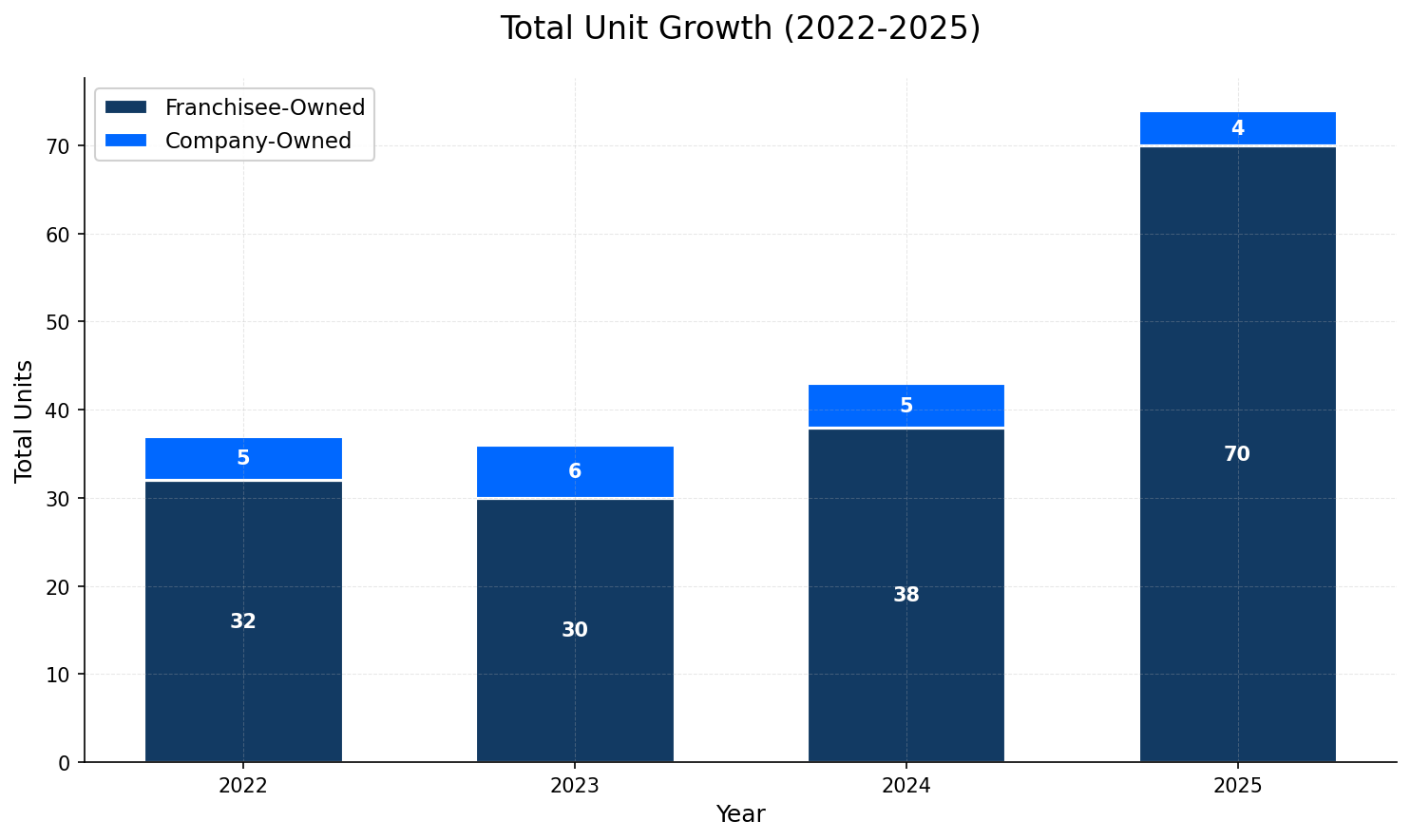
This franchise is on an accelerating growth trajectory: unit counts moved 37 (2022) → 36 (2023) → 43 (2024) → 74 (2025), with YOY rates of -2.7%, +19.4% and a sharp +72.1% most recently. For investors, the rebound from a slight contraction in 2023 to rapid expansion through 2025 signals improving franchise health and strong demand, but the jump from 43 to 74 units in one year raises execution and sustainability risks (operations, training, unit economics) that should be monitored.
Frequently Asked Questions
Is Clothes Bin a good franchise to own?
Whether Clothes Bin is a good franchise depends on your goals, experience, and local market. Key factors from the 2025 FDD: Clothes Bin operates 74 locations, received a legal risk score of 100/100, a training and support score of 54/100. The 2025 FDD appears to include Item 19 financial performance information, but ZeeReport is not showing a number for this report. Prospective franchisees should review the full Franchise Disclosure Document and conduct their own due diligence before making any investment decision.
What is the failure rate of Clothes Bin franchises?
In the 2025 FDD, Clothes Bin reported 0 terminated franchises and 2 non-renewals out of 74 total locations. Franchise closures can result from many factors including market conditions, operator decisions, lease expirations, and franchisor enforcement actions. The FDD's Item 20 provides the most detailed unit turnover data.
How long does it take to break even with a Clothes Bin franchise?
Break-even timelines for Clothes Bin franchises are not disclosed in the 2025 Franchise Disclosure Document. Break-even periods vary significantly based on initial investment level, local market conditions, operating costs, and revenue ramp-up speed. Prospective franchisees should build a pro forma financial model using Item 7 cost estimates and, where available, Item 19 financial performance data from the FDD.
Is Clothes Bin a franchise or a corporate-owned business?
As of the 2025 FDD, Clothes Bin operates 70 franchised locations and 4 company-owned locations. Franchise opportunities are available through the franchisor's disclosure process.
Interested in Clothes Bin?
Get more information and connect with the franchise directly.